The short answer: polarised training works very well for some cyclists, but it isn’t superior to other methods. The often-quoted 80:20 rule doesn’t hold up for elite riders, and it breaks down at the volumes most amateurs train. I’ve seen riders thrive on polarised training, on threshold work and on sweet spot, so I build each rider’s intensity distribution from how they respond rather than from a formula.
What is polarised training?
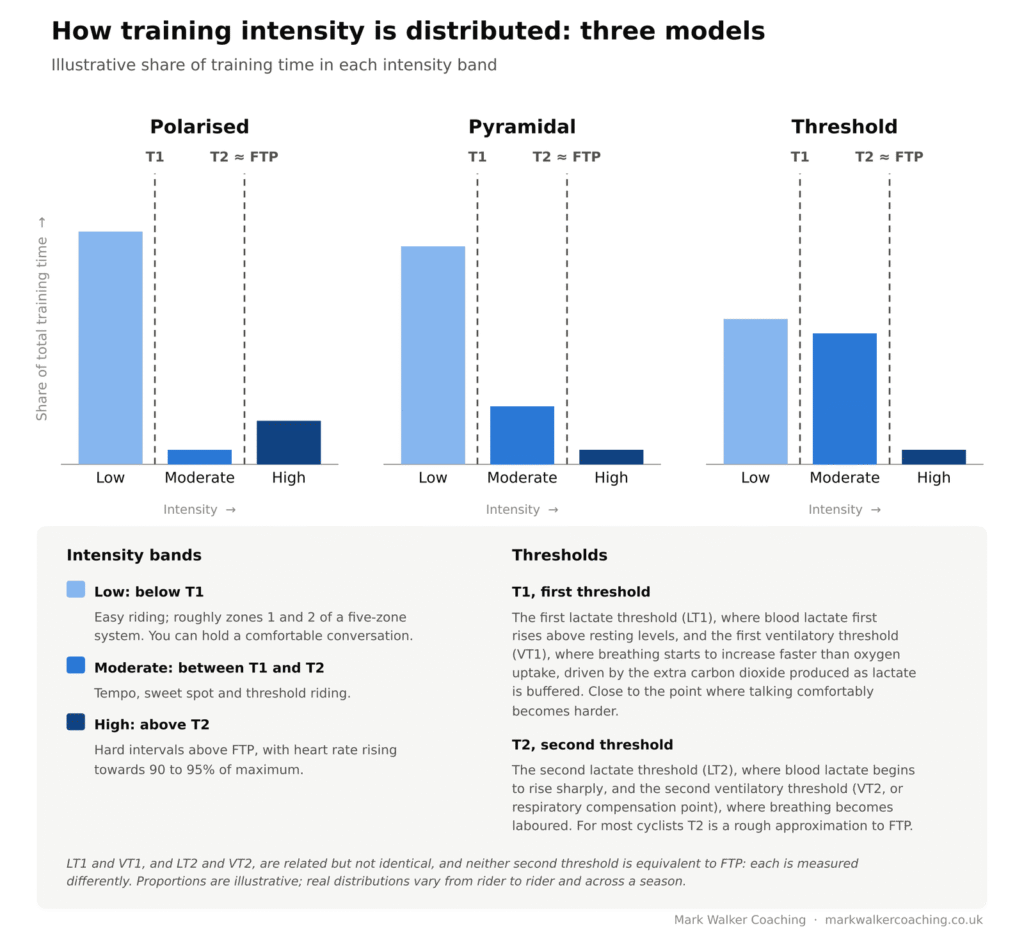
I see polarised training less as a strict formula and more as a philosophy: mix high-intensity training with much easier low-intensity riding, and largely avoid the middle ground.
High intensity, for me, means anything above what is sometimes called the second threshold. That is a slippery term in itself, because threshold measures vary considerably with how you test and how the data are interpreted. For most cyclists, in practice, it means riding above FTP. Strictly, anything over FTP counts, but you can push much harder, to the point where heart rate sits at roughly 90 to 95% of maximum. The aim is to accumulate time at these intensities, although which sessions achieve that best varies enormously from one athlete to the next.
Low intensity means truly easy riding: zone 1 and zone 2, comfortably below the first threshold. This contrast in intensity is important because it helps to ensure the athlete is recovered sufficiently to complete their high-intensity training.
Does the 80:20 rule hold up?
Not in my experience. Among elite athletes, the proportion of true high-intensity work tends to be considerably smaller than 20%. At the other end of the scale, the proportions become distorted at amateur volumes. Eight hours a week is a very different training load from the 25 hours a full-time professional might ride, and the percentages that define polarised training simply don’t translate in the same way.
Is polarised training better than threshold or sweet spot training?
The results I’ve seen are mixed.
Polarised training can work very well for some athletes, and I have employed it to good effect with cyclocross riders from amateur to professional. I usually limit high-intensity sessions to two a week, occasionally three. However, this isn’t the case for everyone.
A good example is a time trial rider I coached, who responded extremely well to a single high-intensity session a week, with four months of consistent gains. That rider went so deep in their weekly session that we decided against adding a second, as we were concerned about the risk of overreaching with little more to be gained. I’ve only coached two or three athletes able to push that hard, and I wouldn’t suggest all endurance athletes should take this approach. Other athletes get their best and most sustainable long-term gains from sweet spot or threshold work, which isn’t polarised at all.
I’ve also employed polarised training at different points in a rider’s development. Some athletes started with a polarised approach early in their cycling career and moved to a more threshold-oriented one later. For others, I’ve used a polarised block in the pre-season, sandwiched between more classical training. It is worth noting that over a whole season, many riders end up with something closer to a pyramidal distribution (most riding at low intensity, less at tempo and threshold, and least at high intensity) as the demands of each phase change.
What the research can and can’t tell you
The biggest misconception about polarised training is that it has been shown to be superior to other methods. I fell into that trap myself early in my coaching career and later experience corrected it.
It is also worth remembering where polarised training came from. It began in applied coaching, not the laboratory: Stephen Seiler observed how successful endurance athletes and their coaches actually trained, and popularised the term “polarised” to describe it. The intervention studies came afterwards, and they have, in my opinion, yet to settle the question.
Much of the case for polarised training rests on studies that are small, short and difficult to compare with one another. Before treating any single method as settled fact, it is worth looking at the statistical limitations of the studies behind the claims: how many athletes took part, how long the intervention lasted, the ability or experience of the athletes, and how intensity was defined and measured.
I honestly don’t think anyone in sports science or coaching has yet pinned down the single best method, and it may be that there isn’t an ‘average’ athlete for whom a given method works best. That isn’t a reason to abandon a scientific approach but it is a reason to treat the research as a starting point, and then to systematically test what works for each rider through careful experimentation and feedback.
Polarised training when you’re short of time
Limited time is where the polarised model is hardest to apply cleanly because the easy volume is usually the first thing to be squeezed out. Lots of single-hour rides in zone 1 or zone 2 don’t do much for a time-crunched rider, so I usually schedule a higher proportion of higher-intensity work to get the most from the hours available.
What that looks like depends on how many days they can train. A five-hour week could consist of two high-intensity sessions, separated by a couple of days off, and a three-hour easy ride at the weekend to add some volume. Some strength training may fit around that too. It may not look like a lot of training, but plenty of people can only manage this, and it can work quite well.
I also adjust the approach through the season to suit what life allows at the time, rather than sticking rigidly to one model all year.
Keeping easy rides easy
Most amateur cyclists struggle with this. Terrain plays a big part: if you live somewhere hilly and can’t face hours on the indoor trainer, heart rate creeps up almost by default. Group rides are another common culprit because they drift to a higher tempo than people had planned.
If the social side of cycling is why you ride, don’t let training spoil it. A very goal-oriented rider, though, may need to ride with a slower group, or accept a trade-off between social riding and hitting their intensity targets.
In practice, I often ask riders to drop to the lower end of zone 2, or even into zone 1, rather than sitting in a comfortable mid zone 2. The aim isn’t to hit one specific zone but to find an easy intensity and volume that complement the hard sessions. If endurance sessions are ridden too hard, it becomes difficult to achieve the required intensity in the high-intensity intervals. Consequently, the easy stuff is too hard, the hard stuff too easy, and everything meets in the middle.
Indoor trainers are very useful for controlling easy rides if you live in a hilly area, although very long rides indoors are tough: discomfort, monotony, heat and dehydration all take a toll.
How hard should the hard sessions be?
Anything above FTP counts as high intensity, but you can push considerably higher. How far a rider should go depends on their recovery, their training age and how rested they are going into the session. There are many ways to structure high-intensity intervals. My preference is for efforts of three to five minutes, which drive heart rate up towards its maximum. That said, plenty of riders do well with short work intervals and short recoveries, such as 30:15 or 40:20 sets. Some sessions begin with a priming effort, a short hard effort that helps heart rate rise high enough in the intervals that follow.
Some riders find it easier to reach a high enough intensity on an indoor trainer, without traffic to think about. Others can’t abide indoor training and do better with hill repeats. Some people also take a long time to warm up for hard efforts, so I often use a ladder structure to ease them into the session and let them find their level. That matters particularly for older riders, and for anyone training early in the morning or late in the evening after a long day.
To judge any of this properly, you need reliable landmarks: an accurate maximum heart rate and threshold heart rate. Without them it is difficult to evaluate one training approach against another. Older riders should also be aware that the gap between 90% of maximum heart rate and threshold heart rate can narrow with age, which blurs those landmarks.
Where does strength training fit?
I treat strength training as complementary to the intensity distribution rather than part of it. It needs careful handling, because the extra load can easily become the straw that breaks the camel’s back. I avoid training to failure, or anything that causes significant muscle soreness because a rider needs to be properly rested to deliver a full high-intensity session, and fatigue from the gym can undermine it.
How I decide whether polarised training suits a rider
I don’t work to a fixed intensity distribution. With a new athlete, I usually start from whatever has worked for them before and refine it, rather than reinventing the wheel. Consistency and systematic refinement produce better results than following any philosophy for its own sake.
When I’m deciding whether a polarised approach fits, I ask:
- Can the rider reach a high enough intensity when the session calls for it?
- Does their life allow enough easy volume to balance the hard sessions?
- What discipline do they ride, and what stage of their career are they at?
- How well do they recover from hard sessions?
- Can they psychologically handle what are extremely tough sessions over long periods of time?
My advice if you’re thinking of trying it
Keep an open mind. If high-intensity training works for you, that’s great. If lots of zone 3, sweet spot or threshold work moves you forward instead, that’s equally valid. We are some way off having a complete answer, and for most amateur cyclists a mix of methods across the season, with the distribution adjusted as you go, will serve you better than following any one approach rigidly.
I was recently asked for my views on polarised training for an article on Nopinz, which is well worth reading alongside this one.
If you’d like help working out the right training balance for you, have a look at my coaching packages.